February 21, 2026 – March 28, 2026
From Galleri Urbane:
“Benjamin Terry lives and works in Dallas, TX. He received an MFA in Drawing and Painting from the University of North Texas in 2013. He has exhibited work in numerous solo and group exhibitions both nation wide and internationally including; N.Y, London, Mexico City, San Francisco and Texas. Recent exhibitions include Chateau Show (2024), The Aldredge House, Dallas, Tx; Done Being Cool,(2024), Galleri Urbane, Dallas, Tx; and Funny Feeling (2025) Paper Mill Projects, Chatham, N.Y. His artwork has been exhibited at the Dallas Art Fair, Aspen Art Fair, and Untitled Art, Miami. Terry was an artist-in-resident at The Maple Terrace, Brooklyn, N.Y. 2018; 100 West Corsicana in 2020; PRIXEL, Hudson, N.Y. in 2025; and the Bodecker project at the Cedars Union, Dallas, TX. Curatorial projects are an integral part of his practice with curated exhibitions at Kirk Hopper Fine Arts, Galleri Urbane, and Texas Woman’s University. Terry was featured in volumes 96 and 132 of New American Paintings, and has received both the Clare Hart Degoyler and the Arch and Anne Giles Kimbrough awards from the Dallas Museum of Art. He is currently a Distinguished Senior Lecturer at the University of Texas, Arlington.
Essay written by Eve Hill-Agnus:
Benjamin Terry’s practice resembles medieval and ancient concepts of the Wheel of Fortune, in its openness to a radical notion of generative movement: circling endlessly, shifting between order and disruptions of order. The desire: to push toward a dialectic. To stumble around. To shake things up and then sit with them, seeing what they can become with more sustained effort and slowness. Recently, something dislodged, broke free—became visible.
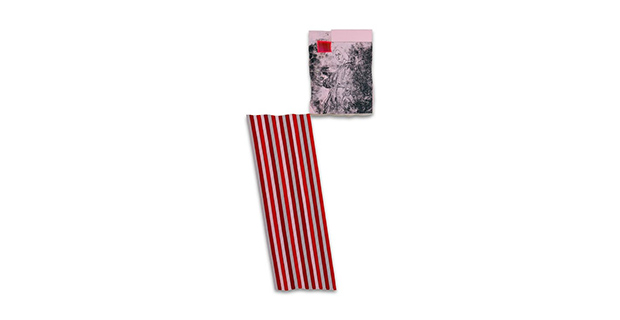
Water Lilies is a continuation of the impetus behind recent work exhibited at Cheerleader, a project space that allowed Terry to open up possibilities, shed constraints, and adopt what he dubs “speed, looseness, and a kind of willful ignorance.” At the heart of that exhibition was a beheading, specifically Terry’s engagement with Caravaggio’s Judith Beheading Holofernes. However, those paintings were neither depictions of a beheading nor allegories of one. Instead, the image operates as a structural and emotional charge, becoming a locus where exposure, humiliation, and the stripping of agency come into view. In Caravaggio’s brutal physicality—in its theatrical darkness and visceral weight—Terry explores violence as both personal and systemic. The beheading embodies a condition: severed, positioned, circulated. That unease registers materially, ruffling the surfaces of the paintings themselves, abstract as they may remain.
Similarly, the works in Water Lilies neither are nor are not about Nymphaeaceae, the common family of flowering aquatic plants. The title recalls Monet’s late paintings, often read as symbols of tranquility and peace after the armistice of World War I, yet made amid profound dolor, guilt, historical violence, and personal tragedy. The artist refuses their resolution. His pieces inherit that dichotomy. Abstraction becomes a container for unresolved feeling. Teetering forms are charged with vulnerability. A plexiglass-rimmed inset formed a hole in one beheading piece. Was it for Holofernes’s head? The artist’s? Ours? The embedding continues in other works, introducing both containment and disruption.
In large-scale, abstract paintings, forms that feel on the verge of collapse evoke gravity and instability. Shapes feel unleashed—tumbling or about to tumble, full of boisterous kinetic energy. Terry brings together the about-to-be and the fait accompli. Pools of reds or pinks register as both playful and grim. Behind the feeling of violence in the roiling colors there is a larger concept. Images function as structures that charge the abstract marks around them. “Those are things I was thinking about in grad school: the relationship between concrete images and abstraction. The potential of a concrete image to inform all of the abstraction around it,” Terry says. “It’s charged in such a fuller way.”
Across his recent body of work, Terry returns to a space he has long been drawn to: the middle ground between the raw and the known. It is an ambiguous, sometimes uncomfortable space—but also one of possibility. Here, concrete images charge abstraction, and abstraction, in turn, keeps those images open. The paintings do not resolve their tensions but stay with them. That commitment—to slowness, contradiction, and not knowing—gives them their density. They feel thick, rich, and full of feeling. “I’m really just trying to let the work guide the work as long as possible,” Terry says.”
Reception February 21, 2026 | 5-7 pm