March 13, 2026—May 2, 2026 | Reception Saturday, March 14th, 4 to 7PM
James Harris Gallery is pleased to present our first solo exhibition with Dallas-based artist Gaurii S Kumaar entitled “Golden Ancestry”. The show will feature Kumaar’s expressive works on paper, both large and small, as well as sculptures created in response to recent visits to her ancestral home.
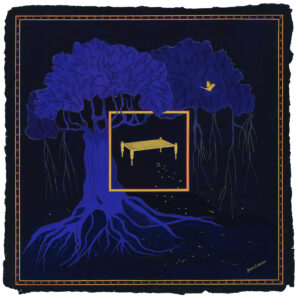
Gaurii S Kumaar’s work investigates the nature of belonging within India’s traditional caste system and its inheritance practices. Using traditional techniques from South Asian miniature painting, influenced by both eastern and western pastoral imagery, Kumaar creates idyllic, dreamlike landscapes that are a personal response to the complex realities of life: birth, death, rebirth, and the tension between free will and predestination. Strongly influenced by family history, her fantastical drawings depict a world imagined by the artist, representing a surreal hybridization of place and subject. In most of her landscapes, a horizon line delineates the composition. This line is often used to create a divide between land and water, where two distinct worlds exist separately and together. Birds, trees, and flowers punctuate the land, while fish, turtles, and lotus flowers float in deep blue water. Often, small, loopy Sanskrit-inspired calligraphic marks, or asemic writings, are used to suggest a language but also act to imbue movement into an ethereal atmosphere. These marks, along with the flora and fauna, become signature iconography for the artist and act as stand-ins for family, history, gender, and the narratives of relationships. For Kumaar, they create a spiritual world in which human dynamics can push against cultural norms. The drawings highlight the fragmentation of memory and time as she captures fleeting moments in today’s shifting environment.
The sculptures, in the form of cots and bricks, also investigate cultural narratives and personal experiences. They explore not only the idea of inherited wealth, often withheld from women, but also the dynamics of caste disparity. In many of the sculptures, Kumaar has used gold as a symbol of privilege. The largest three-dimensional work depicts a beautifully carved wooden cot, partially covered in woven gold leaf, which has been inspired by an object from her ancestral home. The artist has placed jujube berries on top of the gold-plated jute webbing as a symbol for childhood memories, and wooden sandals sit underneath. It evokes absences and solitude while quietly suggesting the value of gender and family legacy. The image of the cot also recurs in another small, intimate, scaled sculpture, but now it has been adorned with gold-plated jewelry and semi-precious stones, symbolizing a heritage of opulence entwined with fragility; rich yet restrained and burdened, again reflecting the complexities and tensions of legacy and inequality. Hand-embroidered fabric draped over bricks also questions societal norms. These four social sculptures reflect themes of hierarchy, entanglement, and control, expressed through specific materials.
Kumaar explores ideas of belonging and inherited rituals through her multidisciplinary practice. Her work addresses gender inheritance and caste disparities. The artist’s iconographic, imaginative landscapes express a psychological and spiritual world that resonates universally. Her sculptures serve as contemporary artifacts that illustrate the cultural struggles of an unspoken, pluralistic society. The artist strives to mold a world where all beings can flourish in a sacred space, feel a sense of belonging, and restore themselves through personal connections. By integrating these creative channels, Kumaar invites audiences to engage deeply with and connect intimately to these overarching themes.