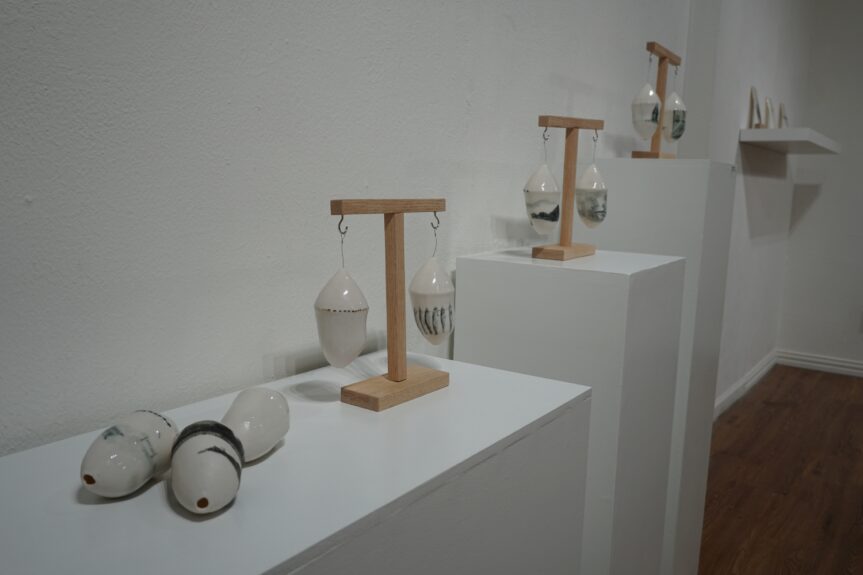
The Goldmark Cultural Center’s Norman Brown Gallery is proud to present “Memory Home”, a solo exhibition featuring ceramic and mixed media sculptures by artist Jack Hein.
The exhibition is on display in the Goldmark Cultural Center’s Norman Brown Gallery from 16 February 2026 to 27 March 2026. The exhibition’s reception date is on Saturday, 28 February 2026 from 6:00pm to 8:00pm. The reception is a great opportunity to meet the exhibiting artist and to learn from him about his artwork.
About the Exhibition
Memory Home is an installation that explores the changing meaning of home through displacement, longing, and transformation. Drawing from Jack Hein’s experience of fleeing Myanmar and growing up as a refugee in Malaysia, the work reflects on how home is not always a fixed place, but something we carry within us across borders.
Throughout the installation, the chrysalis and the bird nest appear as symbols of protection, transition, and vulnerability. These forms represent the temporary spaces Jack once lived in, places that were not permanent but still offered a sense of safety. Made from delicate porcelain, wood, and thread, the work reflects both the fragility of memory and the quiet strength it takes to begin again.
Alongside these forms, food becomes another way Jack understands home. He recreates snacks and simple foods from different cultures that brought him comfort while living far from where he was born. These everyday foods hold emotional memories. A familiar taste or smell can create a feeling of belonging, even in an unfamiliar place. By shaping them in porcelain, Jack preserves their presence while also showing how fragile memory can be.
Influenced by wabi sabi, the philosophy that finds beauty in imperfection and impermanence, Memory Home invites quiet reflection. Through soft textures and subtle forms, the installation offers space for viewers to consider their own experiences of home, loss, and belonging.
About the Artist
Jack was born in Myanmar and moved to Malaysia as a refugee when he was eleven years old, following political unrest in his home country. During his five years in Malaysia, he attended a refugee school and lived primarily in a refugee hostel. These formative years—marked by impermanence, displacement, and adaptation—shaped his understanding of belonging and identity. In 2015, Jack relocated to the United States, where he completed high school, earned his undergraduate degree from Texas Christian University, and is now pursuing his Master of Fine Arts at the University of Dallas.
Jack’s artistic practice emerges from his ongoing exploration of memory, identity, and the emotional landscape of migration. His work reflects the search for a sense of home and belonging—an idea that is both physical and psychological. Through clay, he finds a medium that allows him to reconnect with his past and transform intangible memories into tactile forms. The act of touching and shaping clay often triggers recollections from his childhood, helping him rediscover feelings and images that have faded with time.
His creative process begins intuitively, without a fixed outcome. He allows the material to guide him, starting from simple, organic shapes that gradually evolve as memories surface. Over time, the forms become clearer, carrying emotional resonance and personal meaning. Jack describes this process as a conversation between his hands, the clay, and his subconscious—where each gesture becomes an act of remembrance.
Repetition plays an important role in his practice. The rhythmic and meditative act of forming, carving, or assembling repeated elements becomes a ritual of reflection. For Jack, repetition not only mirrors the cycles of memory—how certain moments return again and again in the mind—but also provides a sense of grounding and peace amid uncertainty. Through this meditative process, he transforms feelings of longing and displacement into works that are both delicate and profound.
In recognition of his artistic accomplishments, Jack recently received an award from the Dallas Museum of Art and was selected as a Carter Community Artist at the Amon Carter Museum of American Art. These honors reflect his continued growth as an emerging artist whose work speaks to resilience, memory, and the enduring human desire to find home.